CLOUDRIFT READING ROOM / SAAS & SOFTWARE
Look beyond
the first sign-in.
Business software becomes part of a working routine. Evaluate the task, the service around it, and how you will move on if your needs change.
A general evaluation guide. The examples below illustrate questions to ask; they are not Cloudrift product specifications or service commitments.
01 / WORKFLOW
One real task tells you more than a feature list.
Take a recurring request: someone submits information, another person reviews it, and a decision needs to reach the right people. Write down the owner of each step and the record that should remain when the task is complete.
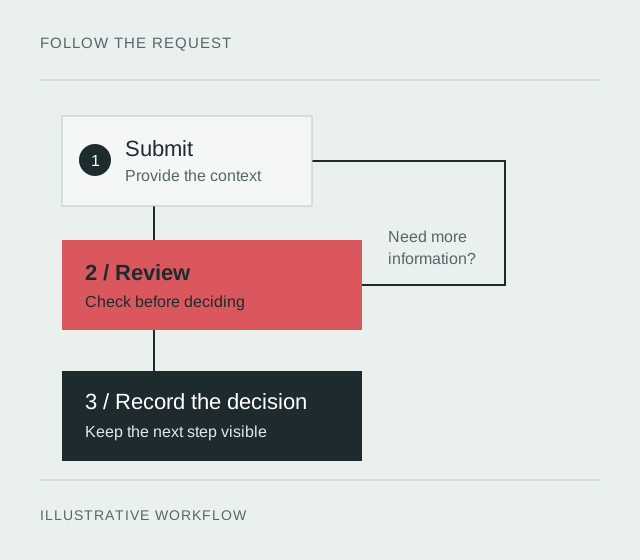
Include the inconvenient paths.
What if the request is incomplete? Who can reassign it? Can the same request arrive twice? What can a user see after permission is removed? These questions expose the behavior that matters in daily work.
A sample input, the decision it needs, and the intended result are enough to begin. Avoid sharing live customer records, credentials, or confidential documents during an initial inquiry.
02 / OWNERSHIP
A hosted service still has shared responsibilities.
The provider operates a service; the customer decides how that service fits its organization. The split depends on the actual product, configuration, and agreement. Use a responsibility table to turn assumptions into explicit questions.
| Area | Ask the provider | Decide internally |
|---|---|---|
| Account access | Which sign-in methods, roles, and access records are available? | Who approves users, reviews access, and removes former users? |
| Information | Where is data processed, and what export and deletion options exist? | Which information is appropriate to upload, and who owns it? |
| Service changes | How are maintenance, releases, and incidents communicated? | Who receives notices and checks the impact on working routines? |
| Recovery | What backup and recovery commitments are documented? | What interruption can the business tolerate, and what is the fallback? |
03 / CONNECTIONS
An integration is a data agreement.
A connector name alone does not explain how two systems behave together. Identify the source of truth for each field, the direction of updates, and the permission needed to read or change a record.
- Direction
- Is information read from one system, written back, or synchronized both ways?
- Timing
- Does an update happen immediately, on a schedule, or only when a user requests it?
- Exceptions
- How are rejected updates, unavailable systems, retries, and duplicate events handled?
- Ownership
- Who investigates an issue, renews credentials, and checks that access remains appropriate?
Ask to walk through a failed update as well as a successful one. A useful evaluation shows how the team discovers the failure and returns to a known state.
04 / ADOPTION
Make the first working routine small and reviewable.
Define one workflow, a limited group of users, and a clear owner. Agree how users will learn the product, where questions go, and which conditions need to be met before a wider rollout.
- Before access: confirm product fit, applicable terms, permissions, data requirements, and the support path.
- During evaluation: use approved sample information; test the normal route and exception routes with the people who do the work.
- Before wider use: review findings, document responsibilities, and decide whether the software is ready for the intended task.
- After adoption: revisit access, workflow changes, service notices, and feedback as part of normal operations.
05 / PORTABILITY
Understand the end before you begin.
Review subscription renewal, cancellation, notice periods, and access after termination. Check which records can be exported, in what format, and whether attachments, history, and relationships are included.

Data deletion and account closure may follow different timelines. Confirm what is retained, why it is retained, and which steps require an authorized request. The provider's written terms and privacy materials should answer these questions for the actual service.